
The World Cup Roared While Someone Died in the Water
Why do we roar for the goal, and fall silent for the dead?

“how everything turns away / quite leisurely from the disaster."
- W. H. Auden, "Musée des Beaux Arts"
The evening had started sunny and seventy degrees, a flawless high-altitude afternoon that Mexico City hands out in June like it has an unlimited supply, and we had walked to Roma Norte sporting knock-off jerseys we'd bought off a street vendor for 150 pesos.
By the time Mexico kicked off against the Czech Republic it was a different planet. It is the rainy season in CDMX, and the rainy season tends to kick your ass. The sky over the valley goes the color of a bruise by late afternoon and then opens with a violence that genuinely rattles the windows, thunder you feel in your sternum, lightning close enough to smell, the kind of rain that makes you understand why the Aztecs kept a god specifically in charge of it.
We were pressed onto a sidewalk with a couple hundred other people outside a place that was less a bar than a collision of glutinous spaces; a food court and a nightclub and half a dozen counters slammed into one cavernous room, a torta stand next to an al pastor spit next to, improbably, an Indian counter ladling tikka masala, screens bolted up everywhere, the most dedicated fans roaring somewhere deep in the back so that their sound reached the street like a single enormous beast bellowing somewhere back in the dark. If you fought your way toward the bathrooms you passed people standing on tables, hanging off the staircases, draped over the rafters, a tattoo parlor somehow doing business in the middle of it, and a knot of men chanting something I couldn’t literally translate but understood the whole meaning of anyway.
Back outside, the rain turned the street into a river and the cars into slow, clunky boats that shouldered wakes up onto the sidewalk and soaked you to the shins if you stood too close. We had given up on staying dry for some time. My friend and I had set two empty beer glasses on a ledge, a couple of Mexican IPAs we’d killed, and watched them fill with rainwater over about fifteen minutes and then, quietly, overflow, into a flood that was already climbing the curb.
Still, nobody left while the game was on.
And what’s funny is almost no one could actually see the game. The televisions were mobbed ten-or-so-bodies-deep, the power kept stuttering, so the match reached the crowd the way news reached a walled town under siege, secondhand, by relay, days late and probably wrong, through whoever had a phone with a signal and a stream that hadn’t drowned. There were lags. The feeds ran at different speeds, so the crowd was never watching one game; it was watching a hundred slightly staggered games, everyone a second or two out of sync with everyone else, each of us marooned on our own small island of time.
Which is why, when Mexico scored, the roar did not go off like a single detonation.
It spread.
It started somewhere near the front, wherever the fastest phone was, and moved back through the crowd body by body, a wall of sound travelling at the speed of everyone’s slightly different signal so that the cheer reached me a half-second after the man in front of me and left me a half-second before it reached the man behind, each of us a node lighting up in turn, a current running through some enormous sonic nervous system laid over the street. Ice cubes from a tequila-based drink flung somewhere overhead. A cloud from a strawberry flavored vape rolled past at face height. A Great Dane in a (also probably knock-off) Mexican jersey did a slow delighted twirl. I roared when the current reached me, one cell in a body of joy the size of a city block, all of us lit up by the same news arriving at all our doors at fractionally different times.
That is what a crowd is built to carry: the loud, the shared, that which wants to spread.
For most of the first half we were just two guys (one goofy gringo, one Chinese-Australian) in the crowd.
A bolt of lightning that served as an introduction to others.
I half saw it happen and half assembled it after. An ancient jacaranda, one from the collection that hover above those streets, a trunk two grown men couldn’t ring with their arms, took a strike and tore loose and came down, dragging the electrical wires with it, a whole-live-tangled-mess, into a street already shin-deep and climbing.
Half the block went black.
The screens we’d been half-watching died.
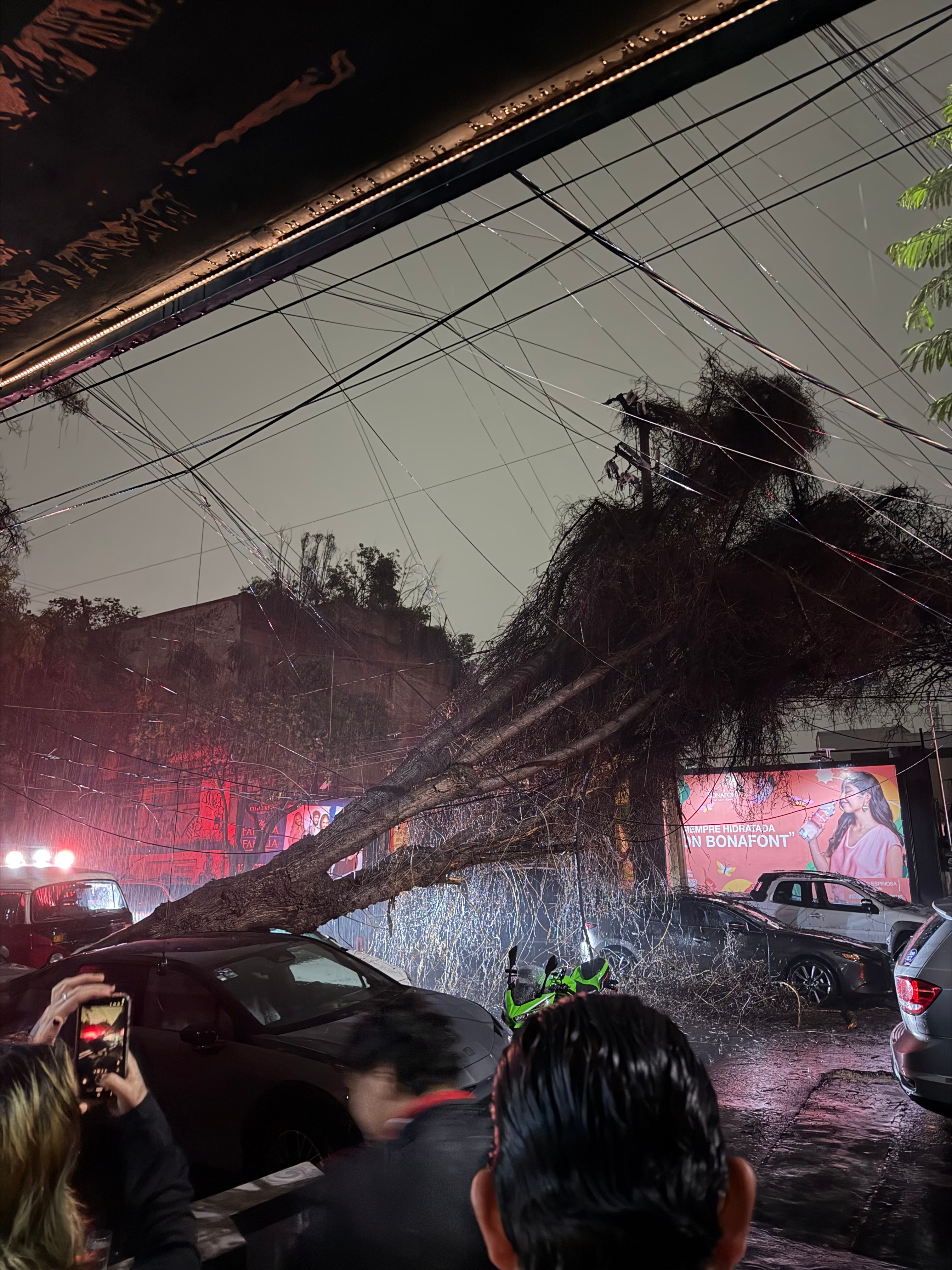
The staff at the bar / food court / nightclub had thrown the doors open and produced pumps (blue ones, fat ribbed things like enormous rubber straws) and pried up the floor tiles to get at the water, and through the gap you could see it: the flood was now running underneath the building, beneath the floor we’d all been standing and drinking and cheering on, a second river under the first. The place had started to smell like sewage. The men worked the pumps and got nowhere and would not stop, and I remember thinking, with the loose profundity of six beers, that it was less like a ship going down than a party going down, a fanbase sinking not into the ocean but into the slow horror of realizing it would not get to see the game.
And two hundred people who a second earlier had been two hundred separate islands, each on our own slightly delayed feed. All turned, at once, to look at the same thing.
The lightning. The tree coming down.
Scored goals made us one crowd a beat at a time, passed hand to hand down the block. The fallen tree hit everyone in the same instant, announcing itself on its own, all at once, for free.
In the dark, you talk to whoever is next to you. Next to us were two young women (one in glasses, one in a hoodie, both up to about my shoulder) and two men, and we said the things you say:
can you believe this? is your phone still working? is that tree going to kill somebody?
We laughed at the last one.
Then they said there was a place a few blocks over with “a computer” that still had the game, and did we want to come.
Before we’d really answered, the worst of the storm arrived, curtains of water erased the far side of the street, and they bolted into it, and we lost them.
My friend and I took shelter under an awning beside a man placidly selling sour gummy bears in the deluge, working out a next move that did not exist.
And then, to our surprise, they came back.
They’d gone half a block, realized they’d lost us, and turned around and come back for us, two soaked, half drunk, disheveled New Yorkers with maybe forty words of Spanish between them, splashing back through the flood to collect us, because, they said, in English bent and softened by their accents:
“We thought you were lost.”
A few strangers reversing course in a lightning storm to make sure two foreigners weren’t lost, walking us, carefully, back through the black water.
The street had become an obstacle course: puddles that turned out to be sinkholes, downed wires you had to trust were dead, whole small lakes where the drains had given up and begun projectile-vomiting back everything they were built to swallow. We went single file, past a salsa club where two nights before I’d watched a fistfight bloom out of what looked like a teenage love triangle. Boys swinging at other boys’ jawlines, girls with fists full of each other’s hair, the whole opera absurd and total and over in under a minute.
They’d said “a bar with a computer,” and I had pictured, God help me, an arcade, a café, something with screens.
What it was, when we got there, was a hole in the wall that could have been a restaurant or somebody’s cluttered front room, power out entirely, lit by flashlights and the cold blue rectangles of phones. The “computer with the game on” was one laptop propped on a stool set on a table so the crowd could see it, the picture freezing every few seconds into that little spinning wheel, the battery ticking down in the corner like a doomsday clock no one could stop. To use the bathroom you held your phone out in front of you like a torch and prayed for accuracy.
The room was shadowy and damp and packed and radiantly happy.
A man sat alone in the corner watching the same game on his own phone, and when the laptop finally surrendered its last percent, it was his phone the whole room turned and leaned toward.
It was here, over warm Pacificos in the dark, that we actually became (however brief) friends with them. Somewhere in there we fell into a sprawling, torrential seminar on astrological signs. I learned that the two women had met only a couple of weeks earlier in Oaxaca and already finished each other’s sentences; that one of the men’s mothers shared a birthday with the friend I’d flown down with, which we treated, at that hour and that blood-alcohol, as staggering cosmic proof of something; that I was, apparently, “so Leo,” the blondeness, the blue eyes, the energy; that one of the women was a Taurus and a “rising” something, which she delivered like a confession and a threat at once.
I did not and still do not know what a “rising” anything means.
I nodded as if it clarified everything.
It was, and I’m not going to pretend otherwise, one of the best nights of the trip.
A girl died in that water.
While we ran to the laptop. While the battery counted down. While the astrology got sorted and the beer went warm and the hardworking men back at the first place bailed the river running under the floor.
Somewhere very close to us, the same few blocks, the flood we were splashing through and laughing in, a girl was electrocuted by the wires the tree had dragged into the street, and she died there.
We did not know for about an hour. And when it reached us, it reached us the way the score had; secondhand, by relay, in fragments, half Spanish and half English, bent by rain and accents and drink.
Una chica. A girl. The wires. On the third floor. No, over there, by the tree.
I never saw her or a body. I saw only, much later, the grammar that gathers around such tragedies. The knot of onlookers gone still, the red-and-blue wash rolling across soaked faces, the steam lifting off the hoods of the emergency vehicles, a couple of cops running flashlights uselessly over the fallen tree.
There is an essay titled “The Death of the Moth” by Virginia Woolf in which she watches a moth die on her windowpane.
A negligible creature, a “little hay-coloured moth” throwing itself corner to corner of its square of glass on a mild September morning, and slowly, over the course of an afternoon, failing and Woolf simply watches.
She gives the whole dwindling struggle her complete attention, and makes, without ever announcing it, a subtle argument:
To witness a death, even an insect’s, is a moral act. The least you can offer any dying thing is to be the one who looked.
What has always struck me about that essay is a single clause. It appears that the moth moves her most, she writes, “when there was nobody to care or to know.”
Damn, a whole ethic in seven words.

The witness matters most exactly where it is least required. Where no one is watching, where the death would otherwise pass unrecorded, where being the one set of eyes is the only dignity left to give.
I have loved that essay for years and continue to love it now.
But since that night in the flood it became almost unbearable for me reread as I prepared for this piece you are now reading because Woolf had something I did not.
She had a windowsill and a silent room and one dying moth with nothing else competing for her eyes. Nothing was rippling through Virginia Woolf’s study; no “GOOOALS,” no crowd, no confetti, no cheap plastic horns, no Corona or tequila flying through the air, no blackout, no two hundred phones screaming a happier truth a half-second apart. She could attend to the moth because the moth was the only signal in the room.
It was the only thing “with wings,” so to say.
I could not attend to the girl because the girl was but one single signal, in a night roaring with every other kind, that the machinery I was standing inside had been built specifically not to carry.
Of particular relevance, Woolf, watching her one small doomed insect, reaches for a comparison and the comparison she reaches for just so happens to be a flood!
A power that could, she writes, “have submerged an entire city, not merely a city, but masses of human beings.” She summons an imaginary deluge to give scale to a single moth’s death.
And here I was with the actual deluge. The real flood, city, and masses. And I gave it less attention than Woolf gave her moth, because her moth had silence around it and my flood had a soccer match on top of it.
So, Woolf’s whole moral world assumes you can govern your own gaze.
Looking is a choice, and therefore a duty.
But, the colder question her essay now puts to me is not:
“Why didn’t you look?”
It is:
“Could you have looked at all?”
There is a maybe-make-believe horror scene I keep playing in my head that revolves around one variable: the sound of the crowd.
That in the seconds the girl was dying, or had just died, two hundred people including me were roaring with joy and the roar was not cruelty, and was not even indifference, because indifference requires that you know and choose not to care. We did not know and we could not have. The information about the goal had reached us; the information about the girl had not; and our hearts were doing exactly what hearts do with the only data they are given, and the data was a game.
I have wondered since whether the last thing she heard, during her final few breaths, was our glee.
(“Life is fragile,” someone wants to say here. “Hold your loved ones close.” Some line off a decorative pillow from Hobby Lobby and I either want to throw that pillow through a window or shove my face in it and suffocate myself. Blah, blah, blah. The point was never that life is oh so delicate. Everyone's life is fragile. The point is that some deaths are built to travel and some aren't, Grant.)
In a course I teach I spend one class period on a single painting. Brueghel’s Landscape with the Fall of Icarus, and the Auden poem written about it, “Musée des Beaux Arts.” It is a lesson I should admit I largely inherited from the colleague I was traveling with in Mexico, who built the best version of this exercise and whom I have been genially robbing ever since.
You may know the painting; I’ve put it below in case you don’t.
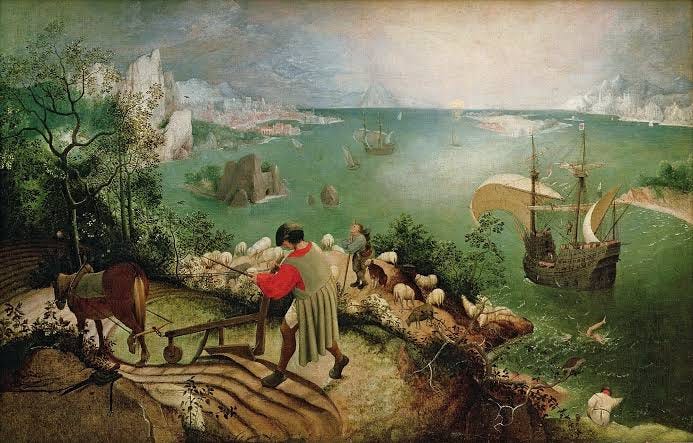
You see a farmer plowing a field, a shepherd gazing up at the sky, a fine ship under sail bound somewhere important, the whole golden afternoon going about its business. And there, in the bottom right corner, almost impossible to find, two small pale legs vanishing into green water.
Squint. You’ll see him.
That is Icarus!
The boy who flew too near the sun and drowned. Who fell, in the myth, into the Aegean off the island of Ikaria, a stretch of sea that has carried his name for three thousand years. And not a single figure in the painting turns to look. Auden’s poem is about exactly that turning-away. Suffering happens, he writes, “while someone else is eating or opening a window or just walking dully along.” The plowman may even have heard the splash and the cry, but “for him it was not an important failure”; and the fine expensive ship that must have glimpsed something astonishing, a boy falling out of the sky, simply “had somewhere to get to and sailed calmly on.”
My eighteenish-year-old students arrive, every term, satisfied, at the conclusion the poem hands you: the world does not stop. The world sails calmly on.
Though, I now think there is an extension of this argument that emerges from the flood in Mexico.
Because Icarus is in the painting. Brueghel saw the falling boy and set him down in the frame. Ignored by everyone inside it, yes, but recorded, permanently, for everyone standing outside it.
The plowman doesn’t see Icarus.
But Brueghel did. And so do we.
The catastrophe is unattended within the world of the image and eternally witnessed by the image itself. Auden’s whole melancholy depends on the boy being there to be overlooked.
The electrocuted girl in the water did not make it into any painting.
There is no corner of that night where, if you look hard enough, you can find her. Icarus fell out of the sky and into three thousand years of attention. A sea with his name on it, this painting, Auden’s poem, my class every autumn. He is perhaps the most exhaustively memorialized drowning in human history. She fell into a flood in Roma Norte on a Wednesday and left, as far as the world is concerned, no trace at all. She is not the ignored figure in the masterpiece. She is the one who was never painted.
And that may be the actual condition of most human suffering: not that it is seen and ignored, but that it never enters the frame at all. This is what Auden’s beautiful cool poem quietly lets us off from facing. It is one thing for the plowman to ignore the Icarus he can see. But the world is full of “Icaruses” who fall outside the frame entirely, drownings no one paints, witnessed by nothing but the water that takes them and a few soaked strangers who will, it turns out, remember it wrong.
That evening, I kept drinking.
After we knew of the death, after una chica, after the sparking telephone lines, after the corpse over there had rippled through to us, my friend and I finished the night. We went to a mezcal bar. And then, we went to a whiskey bar and we danced and we danced and we danced.
I’d like to say I turned my head to look.
I did not.
I was the ship. I sailed calmly on.
I tried to find her.
This is where I should be able to give you her name. It is what the form and the narrative demands.
But, I cannot.
That night (or the next morning), I went back to my AirBnb and I searched Google. In English first, then, knowing better, in Spanish. I read the Mexico City papers for the night of June twenty-fourth, the great storm that drowned the Roma and the Condesa and put all sixteen boroughs under a weather alert in the middle of the World Cup.
And, indeed, there it was.
I found the death! I found my tree! A big-old one, fifteen meters, torn out by the roots at the corner of Querétaro and Medellín. I found my flood, the apartments filling, the pumps in the basements a few blocks from where we ran.
The papers had the night almost exactly as I held it.
Except the papers say it was a man that died. A pedestrian, around twenty-nine, struck by the falling cables, dead at the scene.
Not a girl. A man of twenty-nine.
Hm, interesting.
I have read those articles many times now, waiting for the words to say something else.
For the rest of my trip (and still today, actually) I carried a dead girl. I grieved her. I am building, right now, in front of you, an entire text-based-digital-cathedral of meaning on top of her small imagined body. And it was not even my invention. Many people on that street said chica. Then, further back, niña. The word got younger as it traveled. Young woman, they said. Then girl, they whispered. Then child, they declared.
But, a single death has no signal of its own. It is not a danger the whole street must turn toward, and it does not want to multiply, so the only way it moves at all is by latching onto the one channel that was running that night, the goal's channel, mouth to mouth, phone to phone. And a channel built to spread joy and spectacle does to a death what it does to everything: it optimizes it. It spread to me exactly the way the goal had, through the same warm unreliable crowd.
But it rippled wrong.
So I no longer know what I am grieving. Whether there was ever a girl, or only the man of twenty-nine, transfigured by two hundred wet mouths into something that hurt more. Are the papers even complete? Was there a second death down by the bars that went unrecorded while the photogenic one made the news? I do not know.
Either the network dropped her or the network made her.
The World Cup is still going as I write this. The whole planet is wired into it now; a species briefly synchronized around a ball, the cheer rippling not through one drenched crowd but through all of us at once, continent to continent, the loudest signal our kind has ever built.
The night I stood in that flood (Wednesday, the twenty-fourth of June, 2026) the ground opened in Venezuela. Two earthquakes, thirty-nine seconds apart, came up out of the coast west of Caracas and brought the buildings down. The digging is still going on as I write this; the counted dead are past seventeen hundred and climbing. Tens of thousands of people transformed, by the language of catastrophe, into categories of uncertainty: missing, trapped, unaccounted for, presumed, recovered.
“Missing” is a bureaucratic word for the ones who have not yet been granted the dignity of becoming definite.
They had fallen out of the frame the same night someone died in the water near me. A border away, under another weather system, beneath another ruined piece of infrastructure, entire families were disappearing into rubble while the ball kept moving and the world kept turning its head toward the ball.
I do not mean that as an accusation. It would be easier, morally, if the problem were cruelty. Cruelty gives this essay a clean villain. But most of us were not cruel that night. We were available to what reached us. The goal reached us. The death did not. Venezuela reached me only later, through headlines, when the goal had already claimed the night’s attention for itself.
So why don’t we weep at the volume we cheer? Why is there no roar for the dead the size of the roar for the goal?
Two things can seize a whole crowd at once, and neither of them is grief. The first is old. We were built to snap our heads toward the sudden and the near and the collectively dangerous, because what was sudden and near and dangerous to all of us could kill us, and for a million years that alarm kept us alive. That was the lightning. That was the tree. It was torn from its roots and two faces turned as one. The second we built ourselves: the signal that does not threaten but spreads, that travels because it is made to be passed along, every mouth it reaches becoming part of its transmission. In a few decades we wired it into the whole earth, until the loudest thing our species owns was no longer the nearest danger but the most contagious thing: whatever carries enough charge that the person it reaches cannot hold it, and turns to the next person, and passes it on. That night it was the goal. It was also, I know now, the girl.
Same channel and warm relay, carrying the cheer one way and the rumor of a dead child the other.
A few days after the flood, on one of my last mornings, I was walking to find coffee when a beetle dropped out of the sky in front of me.
It was scary and plump and metallic and green.
The name comes down from Náhuatl, máyatl, “winged beetle,” which is to say the insect had a better-kept name than the girl. It was flying the way they fly, badly, a drunken buzzing helicopter, and as I watched it lost its life force and smacked into the pavement and lay there on its back, legs going nuts, that horrible bright body twitching in the sun.
I walked past it. And then I stopped, and turned around, and went back, and stood over it, and watched.
I don’t fully know why. Writing this, I think it was Woolf, finally. The action I’d failed to take in the flood, available to me now only because the morning was quiet and nothing was rippling, no goal, no crowd, no roar, just one negligible dying creature and a man with nowhere he had to be. And standing there I think I finally understood that my capacity to witness had never been the broken thing. The noise was.
I could give this gross green nothing the attention I could not give a human being, because this time the world had gone quiet enough to let me.
A small girl came down the sidewalk holding her grandmother’s hand.
They stepped around the beetle without seeing it. The plowman and his field, walking past Icarus in the corner, and me the third figure in the painting, the only one looking, and, to them, surely a lunatic staring at filth in the street.
For one ugly second I half-hoped their feet would find it and end that god damn twitching. Please do the mercy I didn’t have the stomach for myself. But, their steps missed. They walked on. They never knew it was there.
The beetle did eventually stop.
I left it where it lay and went and got my espresso.
I still don’t know her name. I don’t know his.
Was she was ever real? Or did the crowd build her out of rain and fear and spectacle? I do know someone died in that water while I cheered half a second behind the man in front of me for a goal I did not even see and now the only way I have to honor this “maybe person” is by giving you what you have just finished reading:
To shape it, and title it, and send it out to travel, with only my name on it.
There may be something to this: "Two things can seize a whole crowd at once, and neither of them is grief."
Los Madres Buscadoras having been roaring for justice for their missing sons and daughters and they are shouting at the world cup too. The contrast between the grieving mothers and the cheers for a goal is striking.
*Also, but unrelated to the quote, some dunk fans from Polanco tried to use one of the Los Madres Buscadoras banners as an umbrella while calling them bad mothers. I know this is a singular incident, but it is symbolic of the world cup from my point of view.
This has transported me to a tragic night in the Hollow Crown ( BBC UK adaptation of Shakespeare's War of the Roses series). The simultaneous nocturnal scenes switched rapidly between queen Margaret's cries of passion, and the muffled calls for help of victims at the hands of assassins. Her seducer was the perpetrator ( he hired the killers in a bid for power). I know it's an entirely different plot, and portrays a loosely factual fiction. However the observer's simultaneous emotions are similarly hard to name as a combination . Bitter sweet is too mild.